On the first page of the brochure sits a chrome object with an expensive name.
On the first page of the customer’s mind sits a question.
Can I get dinner on the table without feeling I have surrendered the evening?
Can I make the report less awful without handing the judgment to a machine?
The brochure ignores both. It announces that the company is a trusted partner for tomorrow. The customer closes it with the quiet efficiency of a person shutting a drawer.
This is a small positioning failure. The brand started with itself.
The question owns the room
Jonah Sachs’s Winning the Story Wars makes the useful narrative correction: audiences are not props in a brand’s tale. They bring the aim. The brand has a part only if it helps them move toward it.
That sounds obvious until a message is being approved. Then the brand biography expands like a very tidy gas. Features, heritage, purpose, and a sentence about excellence begin taking up the available oxygen.
Start elsewhere. Write the question that exists before the brand enters.
A useful customer question is a compact description of a situation, a desired change, and sometimes a cost the customer refuses to pay. It gives a claim a job to do.
BUREAU SYSTEM NOTE 17: The customer has been located. They are not currently reading the mission statement.
A preference is often made, not retrieved
Consumer researchers James Bettman, Mary Frances Luce, and John Payne describe choice as constructive: people often build preferences from the task in front of them, rather than retrieving a finished answer from a cabinet in the head. In three studies, Coupey, Irwin, and Payne also found that familiarity with a product category changed how people formed preferences across different tasks.
The question helps construct the decision. Ask, “Which accounting package is best?” and you invite a spreadsheet duel. Ask, “How can a two-person studio send invoices without losing Friday afternoon?” and a different set of trade-offs becomes visible.
The brand’s role becomes clearer too. It can be the ladder, the map, the warm coat, or perhaps the unusually dependable invoice button.
Intelligence makes the missing question visible
This matters more as recommendation moves into conversation. A 2025 Google Research paper notes that preference elicitation is crucial when a system has little user history. Even advanced language models still struggle to ask effective sequential questions. Another Google team built a system that improves generated image choices by adapting through a sequence of user preferences, rather than assuming one prompt tells the whole story (PASTA, 2025).
Their scope is narrow. Their lesson sharpens an old brand discipline: a fluent answer is weak when it has not found the question.
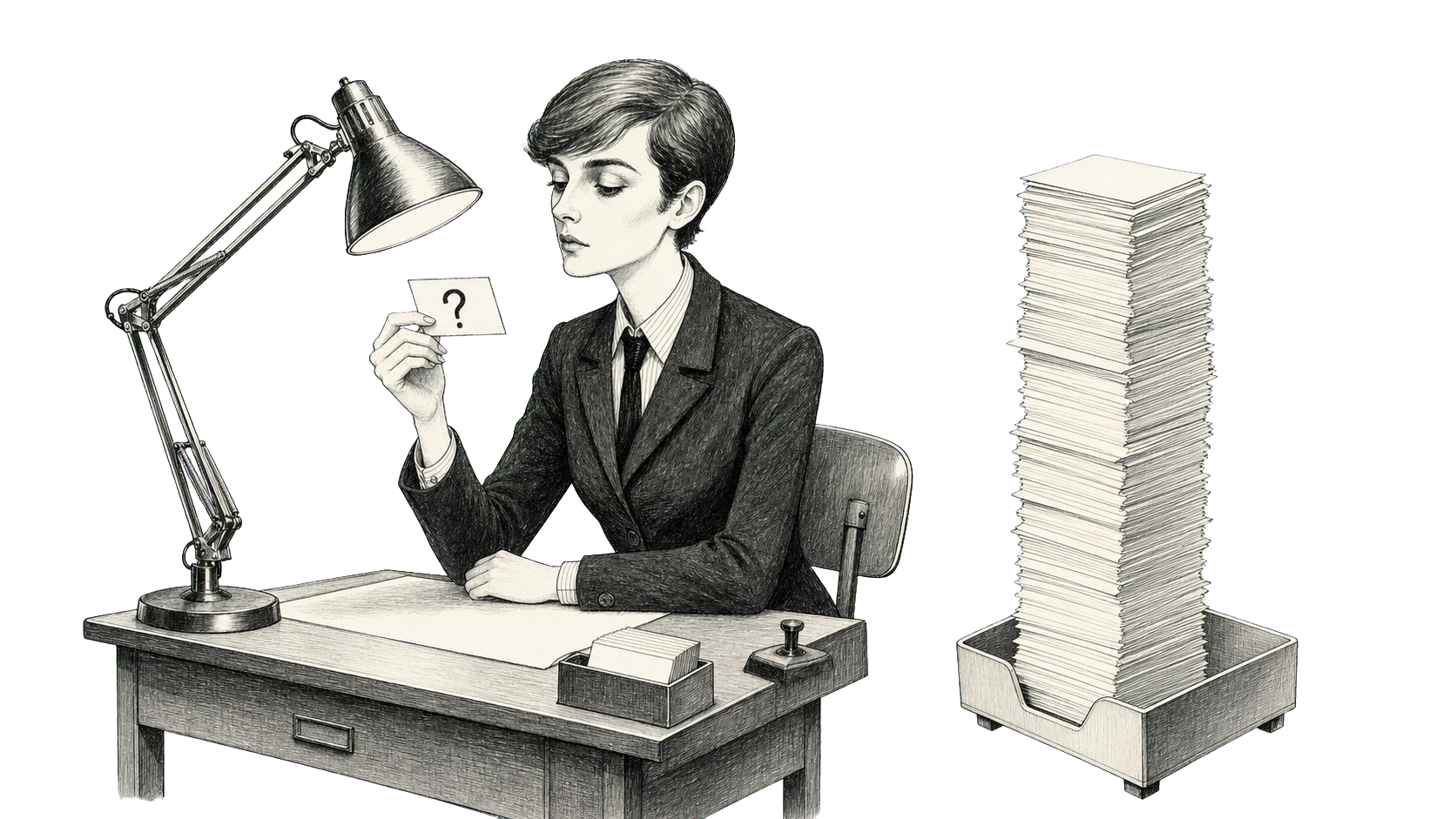
Before writing the next claim, make a small card:
- The moment. When does the customer need to decide, repair, avoid, or begin?
- The question. What progress do they want, and what are they unwilling to give up?
- The answer. How does this offer help, with what proof, unlike the alternatives?
Test the card with real people. The first version may be wrong. That is excellent news. A wrong question discovered early is cheaper than a beautiful campaign answering it for six months.
The brand can remain ambitious. It simply arrives after the question has opened the door.
Continue with A Brand Should Give People Something to Do and The Brief Is Not a Vending Machine.