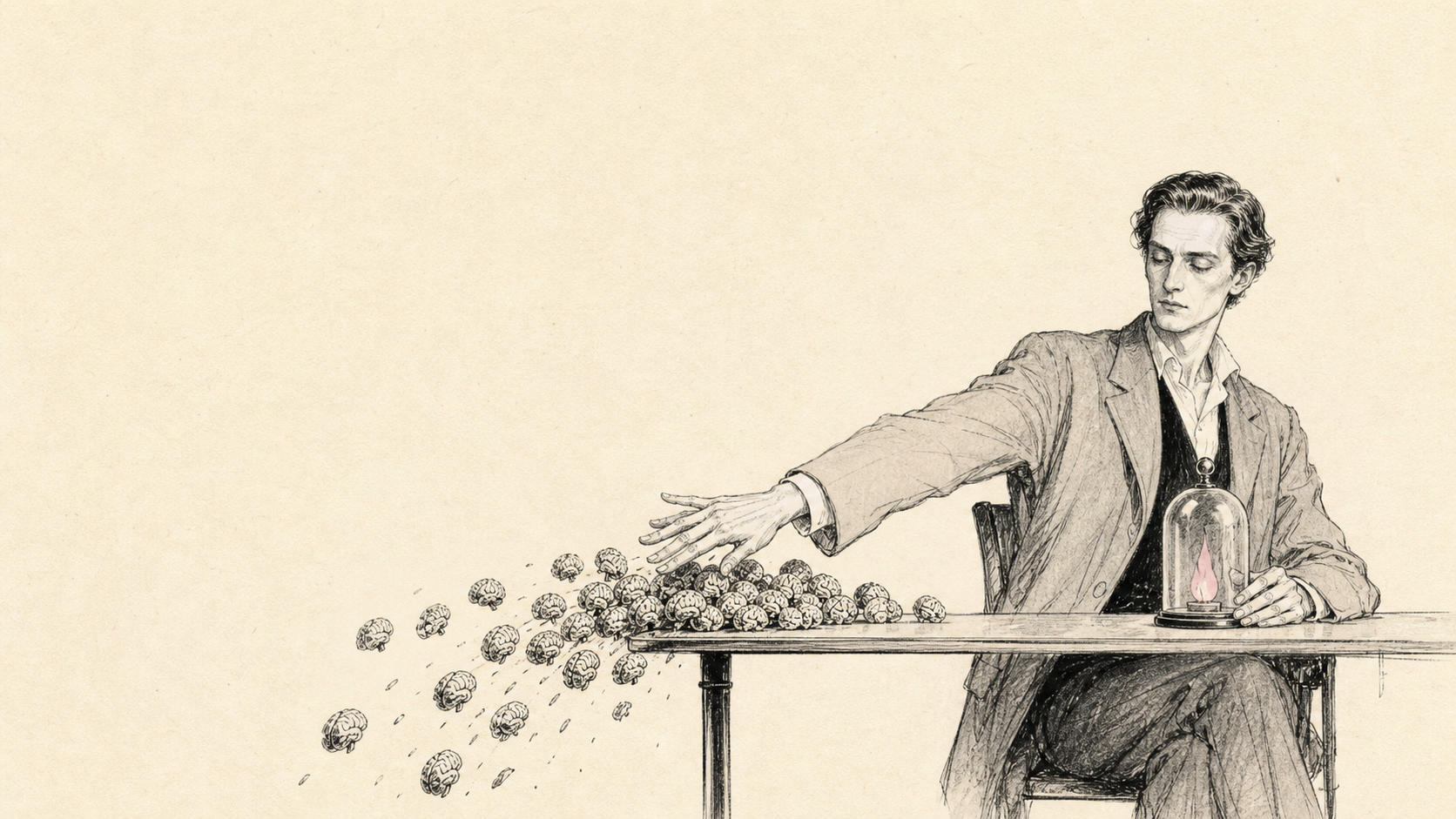
Competence is becoming inexpensive.
A company can now produce in one morning what once required a week, a team, and an alarming quantity of sticky notes.
This is useful.
It also creates a small problem: when everyone can make competent work, competence no longer explains why anyone should choose you.
Products gain similar features. Services gain similar assistants. The language becomes polished before anyone decides what they believe.
When intelligence becomes common, scarcity moves elsewhere: to conviction, taste, memory, and meaning.
That is where brand begins.
The competent beige future
AI raises the floor. Small organizations can now use analysis, code, language, and design once reserved for companies with many floors and a disappointing canteen.
Excellent.
But if every bank has an assistant, no bank can own the assistant. The same applies to the consultancy summary before lunch and message 743 from the content engine.
The machinery can make things.
It cannot decide what deserves attention.
BUREAU SYSTEM NOTE 02: One thousand brand messages were generated. Meaning was not present in the shipment.
Brand belongs before the ribbon
Brand is often added after the serious decisions: a name, a typeface, a story, perhaps a film featuring a desert.
This is backwards.
A brand is what people remember and expect. Inside a company, it is also a filter. It tells people which choices belong together and which tempting ideas should be shown the door.
This matters because AI creates an option problem. You can make more products, more messages, more channels, and a podcast by Thursday.
The fact that something can be made does not mean it belongs.
A good brand behaves like a very polite bouncer:
- it admits some opportunities;
- it declines others with genuine regret;
- it makes new offers strengthen the same memory;
- it helps people explain why they choose you.
“Empowering people” is not enough. It could describe a bank, a blender, or a regional airport.
Meaning becomes useful when it excludes.
When everyone gets the feature
Positioning often begins with a feature competitors do not have.
But AI makes feature gaps close quickly. So the interesting territory moves upstream—to a worldview, a tension, a particular audience, or a different idea of value.
Ask:
- Which future are we making easier to believe?
- What do we understand that the category ignores?
- What will we refuse to optimize away?
- What should people remember when all products work well?
A beautiful promise that dies during customer service is costume, however excellent the storytelling.
Room 4B: imagine first
Brand strategy often studies the present: customer needs, competitors, open positions.
Useful. But research can describe today perfectly while making tomorrow impossible to see.
Try stranger questions:
- If intelligence becomes free, what becomes expensive?
- If creation becomes instant, what becomes worth waiting for?
- If personalization is everywhere, when does a shared experience feel special?
- If every company speaks fluently, which silence creates trust?
They shape preference and change what the organization does. Brand and strategy may share the room without filing a complaint.
The five-line brand brief
- Future: What change are we preparing for—or creating?
- Tension: Why does it matter to actual people?
- Role: What particular place will we occupy?
- Proof: What must we do to make it true?
- Memory: What should accumulate whenever we act?
Everything else—the campaigns, channels, generated assets, and podcast—serves those five lines.
Competence will remain necessary.
It will simply become less memorable.
Use abundant intelligence. Keep a specific identity.
The Bureau sees no reason to become beige merely because beige is now extremely efficient.