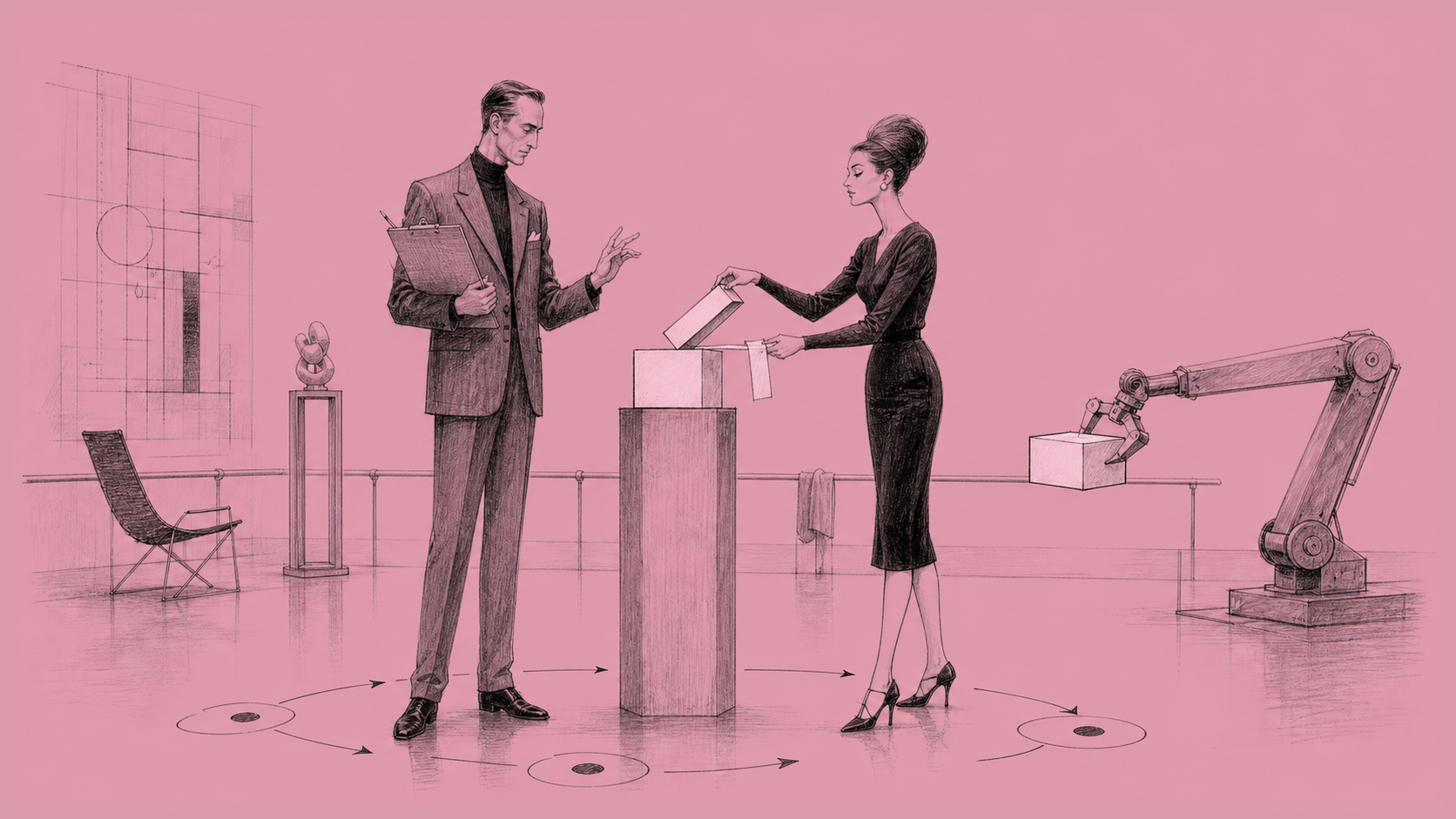
The twist, peel, pour, fold, stamp, and wait often survive long after the campaign has been placed in archival storage.
They survive because a brand ritual gives meaning a body.
People do not merely hear what the brand stands for. They perform a tiny version of it with their hands.
This matters now. AI has made it possible to produce more messages, in more shapes, for more audiences, before anybody has located the good scissors. The IAB reported in 2025 that more than half of the marketers it surveyed were already using generative AI for creative content and audience targeting. Nearly all planned to expand their use.
The feed will not suffer from a shortage of rectangles.
The scarcer thing may be an act worth repeating.
Meaning with its sleeves rolled up
A ritual is an ordinary action given unusual attention.
It need not involve candles, chanting, or a regional hat. It can be a particular way to open something, begin something, share something, or mark that something is complete.
In a series of experiments, researchers found that small rituals could increase enjoyment and involvement in consumption. Performing the ritual oneself mattered more than merely watching somebody else do it.
That distinction is useful for brands. Communication asks people to receive meaning. Ritual lets them rehearse it.
Later research on unfamiliar brands found that a simple ritual could help create consumer connection at the beginning of the relationship, especially when people paid attention to the act. The ritual did not need a century of heritage and a brass plaque. It needed participation.
BUREAU SYSTEM NOTE 16: The customer has touched the product. This event was not included in the media plan.
Give the idea a small choreography
Start with the brand’s intended meaning. Then ask what a person could do that makes that meaning briefly true.
Use four pieces:
- An object. Choose something already present: a label, lid, receipt, button, box, doorway, sound, or first screen.
- A sequence. Make the action distinct enough to remember and easy enough to repeat without an instructional webinar.
- A significance. The act should express the brand idea. A brand about care might invite a pause. A brand about curiosity might reveal something hidden. A brand about collective progress should probably involve another human being.
- Some freedom. Leave room for people to adapt, teach, photograph, mispronounce, and eventually claim the ritual as their own.
AI can help generate possible actions, remove awkward steps, and test whether the instructions make sense. It is less qualified to decide whether the ritual feels worth keeping. That requires a body, a context, and occasionally a lid that refuses to cooperate.
The boundary matters because emotional communication is unusually sensitive to authorship. Across preregistered experiments, Kirk and Givi found that emotional marketing messages believed to be AI-written produced lower positive word of mouth and loyalty than messages believed to be human-written. The effect was smaller for factual messages and when AI edited rather than authored the communication.
The models may remain outside the cupboard. The useful division is simpler: let AI assist with the message, and keep human intention visible in the meaning.
Test for useful repetition
Do not judge the ritual by how charming it looks in a presentation. Put it into the untidy world.
Watch for four things:
- Can somebody perform it after seeing it once?
- Does the action improve the experience, or merely delay access to the biscuit?
- Does it express something specific about this brand?
- Do people repeat it when nobody is offering points?
Research across nine brand communities found that value grew through shared practices such as welcoming, documenting, celebrating milestones, and helping other members use the brand. These actions worked like apprenticeships: people learned how to belong by doing things together.
That is more durable than reach alone. Reach can show a person the brand. A ritual gives the person a role.
Most brands will continue publishing. This is sensible. The internet would become suspicious if the rectangles stopped.
But a useful brand ritual can move somewhere content cannot. It enters the kitchen drawer, the first five minutes, the way a package is passed across a table.
If people notice when the act disappears, the brand has made more than a message.
Continue with A Brand Is a Grammar, Not a Template and When Intelligence Is Cheap, Meaning Becomes the Moat.