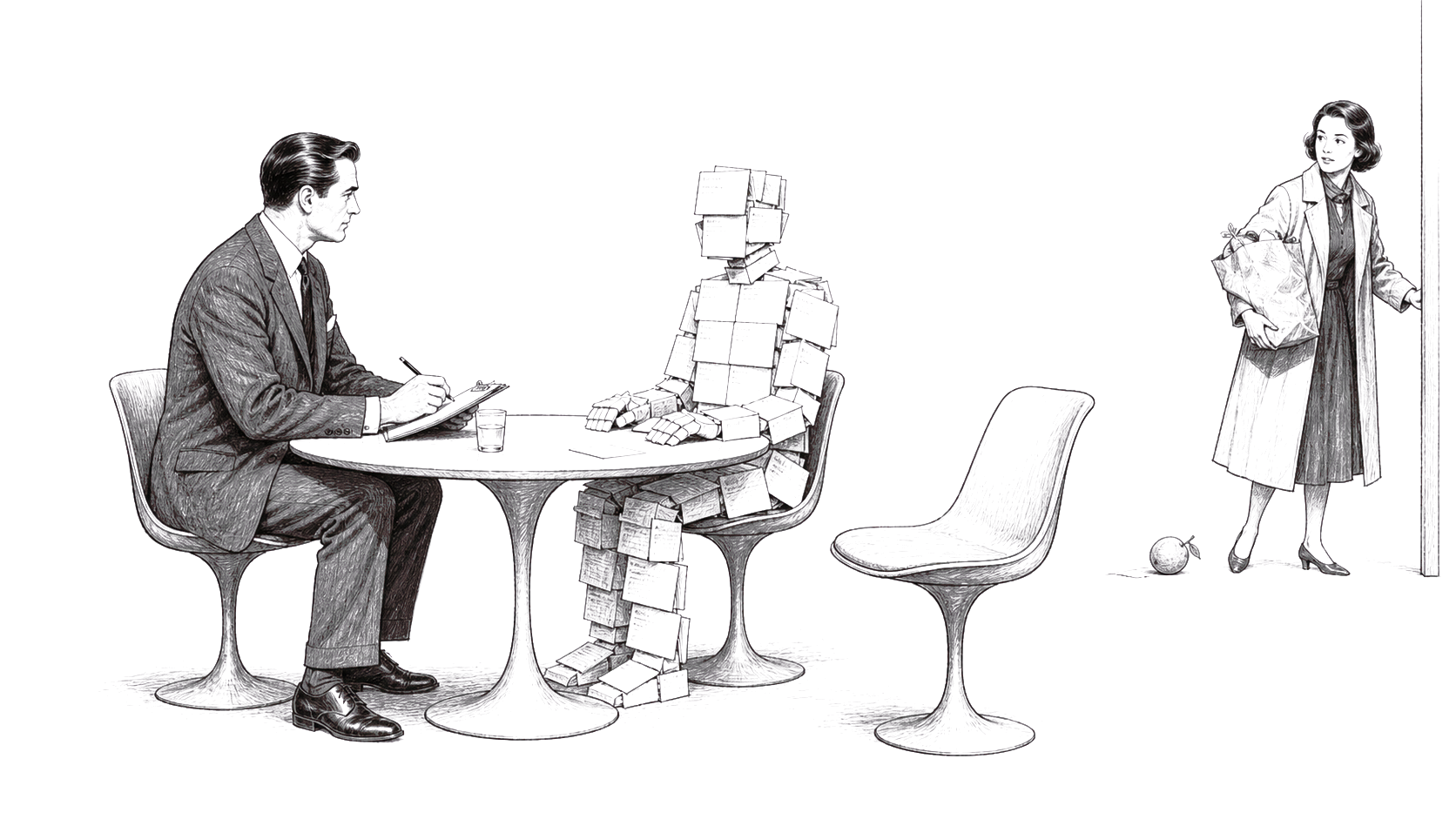
The synthetic customer has excellent manners.
It arrives on time. It explains its needs in complete sentences. It has a name, a job, three anxieties, and a sensible opinion about your new service. It does not ask why the delivery window is so vague. It has never been late for a bus with a leaking bag of oranges.
The trouble begins when good manners are mistaken for evidence.
Teams can now ask a model to invent a focus group before the printer has warmed up. The results often sound perceptive. They should not be treated as customer evidence. A synthetic customer is an informed rehearsal of what the team and the internet already make imaginable. It cannot reliably reveal the person, context, or irritation outside that frame.
A plausible answer is not an encounter
Immanuel Kant spent several hundred pages arguing that the mind helps arrange what it can know. The Bureau requires six words: every research method brings a frame. Ask what yours has made difficult to see.
An AI persona has an unusually firm frame. It produces a response from patterns in its training and prompt. It can help a team expose an assumption, draft an interview guide, or imagine a neglected use case. But it has no last Tuesday. It did not abandon the purchase because the checkout required an account while a child was shouting from the next room.
In a 2025 study of opinion polls, Julien Boelaert and colleagues found that the models they tested could not replace people for opinion or attitude research. The answers varied too little, and their bias shifted from topic to topic.
BUREAU SYSTEM NOTE 22: The customer has been simulated successfully. The surprise has been archived as an outlier.
The average has no rough edges
That low variation matters to brand work. Averages are convenient when choosing the centre of a chart. They are poor at showing why somebody refuses, improvises, feels foolish, changes their mind, or finds a new use for an old thing.
In a 2025 Nature Machine Intelligence paper, Angelina Wang, Jamie Morgenstern, and John P. Dickerson compared model portrayals with human data from 3,200 participants across 16 demographic identities. They found that the models could misportray and flatten groups. More temperature did not repair that flatness.
Another CHI study asked 19 qualitative researchers to inspect model-generated participant material. The researchers recognized familiar narratives at first, then identified missing contextual depth, consent, and agency as the conversation continued.
The synthetic customer can recite a familiar story. A real customer can spoil it. For a brand, the spoiled part is often the valuable bit: perhaps the category is wrong, the assumed problem is a minor nuisance, or a humble feature has become part of someone’s ritual.
Use the model before the door opens
Let the model work before research, not in place of it.
Give it the proposed customer claim. Ask it to produce the strongest ordinary objection, the missing constraint, and the question the team is avoiding. Then turn those into open prompts for real conversations. Do not ask people whether the persona was accurate. Ask for the last time the situation happened. Details have mud on their shoes. They are harder to obtain and much less likely to salute your premise.
Give the machine a job it can do: prepare the map, mark the blank edges, and hold the coat. Customer research begins when someone tells you what the map forgot.
Use The Unseen Chair before a synthetic insight turns into a synthetic certainty. Then continue with Write the Question Before the Claim and The Machine Cannot Recommend What It Cannot Name.