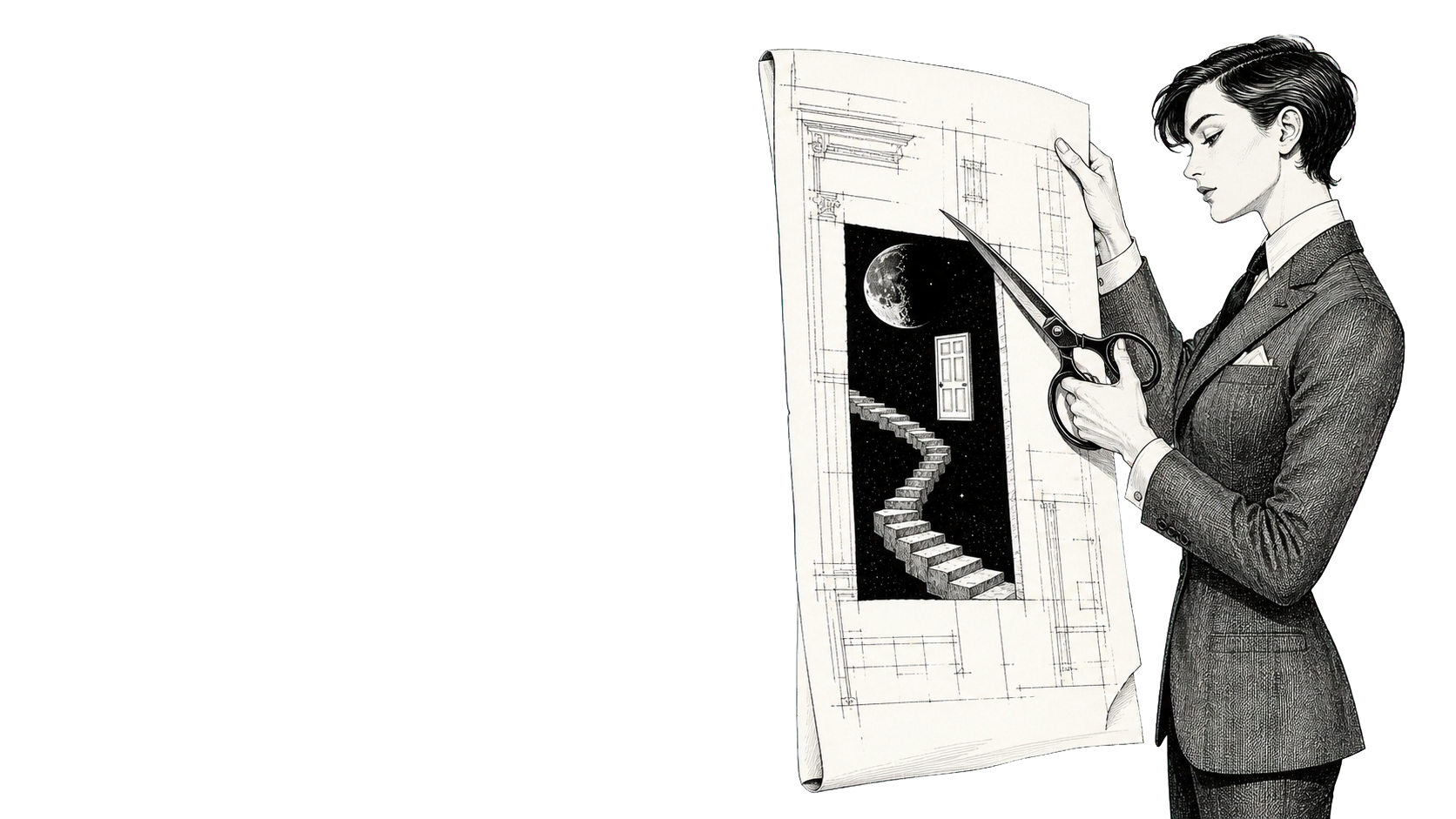
Most organizations have a detailed picture of the future.
It looks remarkably like the present, only with better numbers.
The present arrives with evidence, budgets, and Martin from Procurement. The future arrives empty-handed and asks whether the category still needs to exist.
Naturally, the present tends to win.
We forecast what we can already see—and call it strategy. Information is plentiful. Imaginable alternatives are kept in a much smaller cupboard.
The ruler and the scissors
Forecasting owns a ruler. It extends the line.
Imagination owns the scissors. It changes the paper.
A forecast asks: what if this continues?
Imagination asks: what if the category disappears? What if the expensive advantage costs €19 next Tuesday? What if customers simply stop caring?
Strategy needs both. But imagination goes first. A different future cannot be chosen until someone makes it visible.
The machine brings options
AI is useful as a counterfactual accomplice. It can attack assumptions or invite unusual witnesses:
- the customer who left;
- the competitor with no legacy systems;
- the regulator in a bad mood;
- a twelve-year-old with no patience for your category.
Used well, it supplies alternatives. Used badly, it produces five polished synonyms for “continue.”
BUREAU SYSTEM NOTE 03: A plausible future has been generated. Originality remains an optional accessory.
Do not ask for “five innovative strategies.” Give the machine a stranger job:
- argue that your greatest strength will become useless;
- describe your industry without its main product;
- combine your business with a museum, a game, or a railway timetable;
- design a competitor that finds your normal rules hilarious.
The machine can multiply and rearrange. It cannot decide which future deserves a bet. That remains human work, which is fortunate: the machine has no appetite and no reputation to lose.
Turn one thing upside down
Choose an assumption that everyone treats like gravity. Write its opposite.
- Customers need onboarding → customers refuse onboarding.
- Our data is the moat → useful data becomes free.
- Trust requires a person → people trust the system more.
- Bigger is safer → smallness becomes the advantage.
Now ask:
- What would make the opposite true?
- What tiny signal would show it is beginning?
- What small, reversible bet could we place now?
Let AI produce possible worlds. Select one with judgment and a modest amount of courage.
The aim is not to predict the future correctly. The future has repeatedly declined this service. The aim is to avoid living inside the only world your spreadsheet knows how to draw.
Strategy is not choosing confidently inside today’s drawing. It is deciding which drawing to test next.
That makes the imagination deficit a strategy problem. It merely happens to be wearing very sensible shoes.