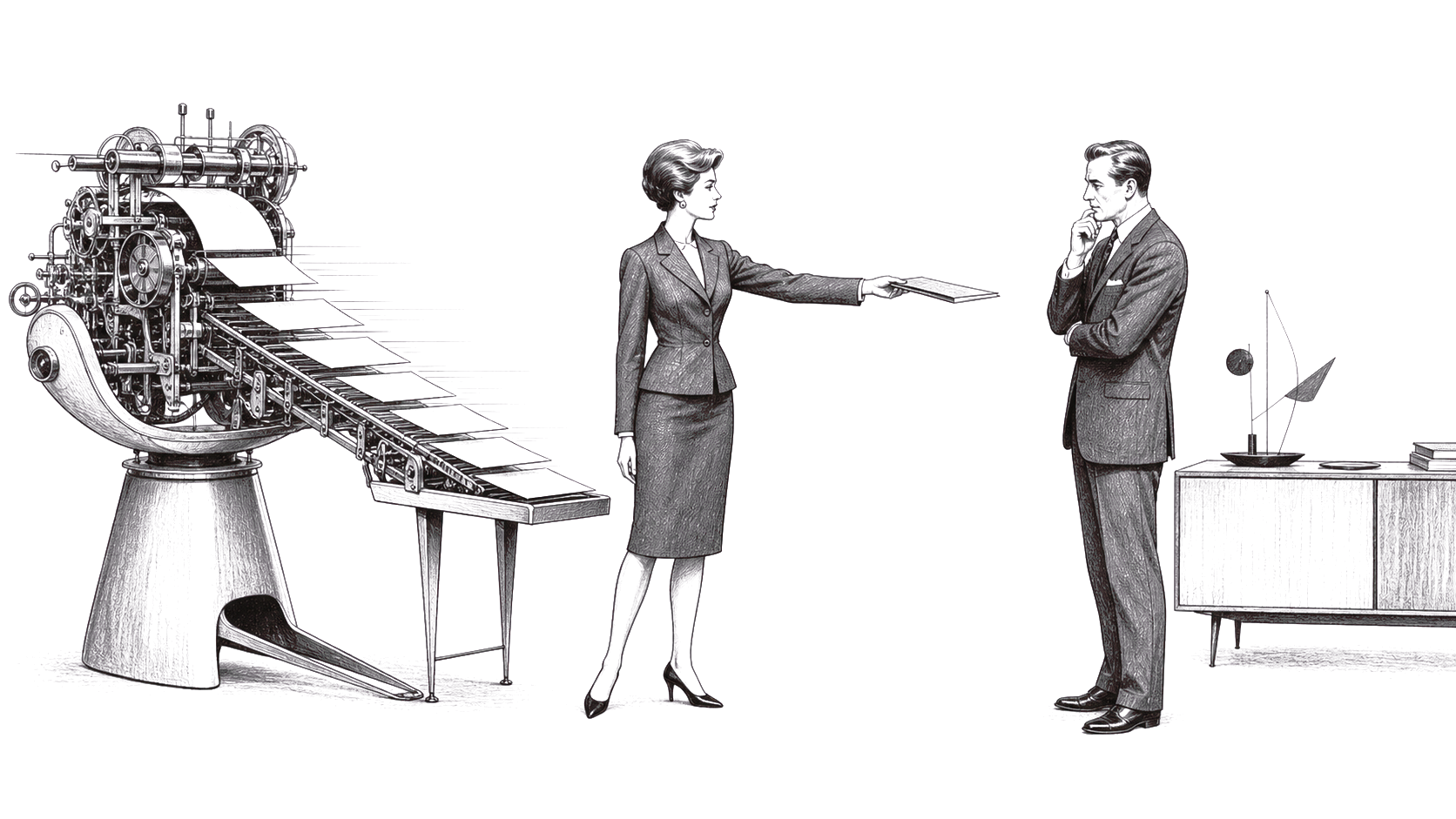
A fast output can be the slowest object in the room.
It appears in seconds, polished and eager. Then it waits. Nobody knows who should act, what should change for the customer, or which assumption would make the whole thing useless.
AI has compressed the making of the document. It has not compressed agreement.
Saved time has somewhere to go
The evidence is pleasingly awkward. In a six-month randomized field experiment across 66 firms, Dillon, Jaffe, Immorlica, and Stanton gave 7,137 knowledge workers access to Microsoft 365 Copilot. In the second half of the experiment, regular users spent two fewer hours a week on email. The researchers found no broad shift in the quantity or composition of people’s work. This is an NBER working paper, and three authors worked for Microsoft during the study.
The tool saved time inside familiar work. The surrounding organization mostly kept its shape.
Stanford’s 2026 AI Index reports that 88% of surveyed organizations used AI in at least one function in 2025. The largest measured gains appeared in structured work with outputs that are easy to monitor. A finished spreadsheet is cooperative with a ruler. Shared direction is not.
BUREAU SYSTEM NOTE 21: The draft has arrived early. Its destination remains a matter for the relevant mammals.
Crossing a silo is only half the journey
A 2026 product-innovation experiment with 791 Procter & Gamble professionals found that individuals using AI matched the performance of teams working without it. The preregistered study also found that AI users produced more balanced proposals across research-and-development and commercial backgrounds.
The tool helped knowledge cross a functional border. Human judgment still mattered when ideas had to be selected. The hand-off has moved: less effort may be needed to assemble a plausible proposal, while the choice of what deserves action remains stubbornly human.
The OECD’s 2025 review of experimental research is similarly careful: results vary with the task and the user’s experience, while long-term business effects remain poorly established.
The machine can make the parcel quickly. The organization must still put an address on it.
Put one sentence on the parcel
Before an AI-assisted item moves to another person, add a hand-off sentence:
This helps [person] do or decide [thing] by [change], if [assumption] holds.
For example: This helps a new customer choose a savings plan by showing the trade-off in plain language, if they can see the figures before the sales call.
This sentence is a test, not a tiny executive summary. If the next person cannot name the action, the customer, and the assumption, the work is not ready to travel. Footnotes may remain seated.
Use The Hand-Off Sentence on one item this week. Let the machine make the first version fast. Then make the purpose visible enough for another human to carry without dropping it into the ornamental pond.
Continue with Do Not Summarize the Disagreement and The Brief Is Not a Vending Machine.