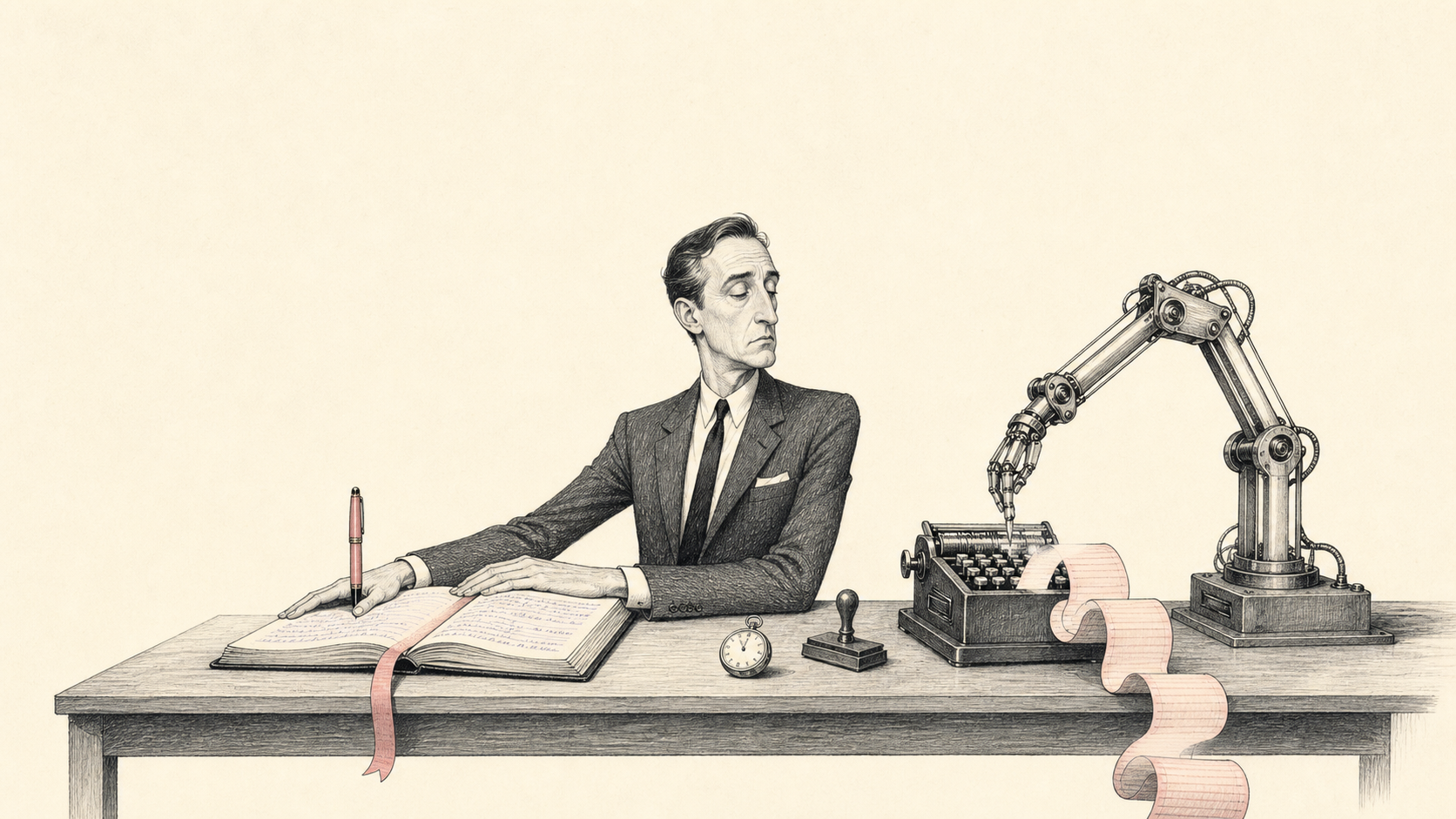
Every shortcut leaves something at the coat check.
Navigation software finds the fastest road and takes a little sense of direction as its fee. A customer-reply bot may take the awkward ten minutes in which somebody discovers why the reply is true.
Often, this is an excellent arrangement. The Bureau has no sentimental attachment to copying numbers between spreadsheets.
The cost, when there is one, is paid in practice. A task disappears; the ability it exercised begins to soften.
Scott Barker asks the question that belongs on every AI purchase order: “Which abilities are we comfortable trading?”
That turns adoption into a negotiation. Speed is written clearly on one side. The other side deserves reading too.
The shortcut rehearses something
Work produces an output. It also rehearses an ability.
Writing a proposal exercises explanation. Comparing options exercises judgment. Reading customer complaints builds a feel for the customer. The finished document is visible; the rehearsal usually is not.
AI changes both.
In a 2025 survey of 319 knowledge workers, Microsoft researchers found that greater confidence in AI was associated with less reported critical-thinking effort. Self-reporting cannot establish that anyone became worse at thinking. It does suggest that a smooth answer makes inspection feel optional.
How the tool enters the work matters. In a field experiment with more than 200 chess students, learners who could request AI help at any moment improved less than those whose help arrived at selected moments. Both groups improved. One group had a little more useful struggle.
Useful struggle is badly represented in quarterly dashboards. It tends to arrive looking untidy and asking for seven more minutes.
BUREAU SYSTEM NOTE 14: The answer is complete. Knowledge of how the answer works has been moved to optional storage.
AI can also strengthen a skill. In pre-registered writing experiments, Harvard researchers found that people who practised with an AI tool improved on a later unaided writing test. Examples, feedback, and well-timed questions can make the machine a coach.
The important design choice is whether AI merely finishes today’s task or leaves the person better prepared for Thursday.
Open the capability ledger
Before automating meaningful work, take one plain sheet of paper. Divide it into four columns:
| The task | What AI gives us | What we practise less | Our decision |
|---|---|---|---|
| First proposal draft | Speed and structure | Forming an argument | Human writes the claim first |
| Customer-call summary | Searchable notes | Hearing hesitation | Salesperson adds the three moments that felt odd |
| Brand review | More variations | Taste and refusal | Team chooses before seeing the machine score |
The last column matters most. Choose consciously among three perfectly respectable decisions:
- Trade it. The ability is no longer worth the time.
- Keep it. People still need to perform it without assistance.
- Rehearse it differently. AI does the routine work while people practise the judgment underneath.
The OECD’s review of generative AI makes the practical point: immediate performance gains do not guarantee long-term learning. The outcome depends on how the tool is used.
Keep the abilities that guard the door
Preserve abilities that protect quality, trust, or direction. A brand team should still know when an idea feels borrowed. A strategist should be able to trace an assumption. A manager needs to hear when “interesting” means “please stop.”
These abilities inspect the machine’s work and decide where the organization goes. Losing them creates an impressive system with nobody left qualified to be unimpressed.
So keep the twelve-second customer reply. Then ask one person to explain why it is true before pressing send.
The trade is probably worth making. It should still have a signature.
Continue with The Intelligence Stack and AI Strategy Is Not a Technology Roadmap.